Since 2006,Howvin Most famous outdoor furniture brand, best choice for Hotels, Resorts, Restaurants and Villas.
Language
Since 2006,Howvin Most famous outdoor furniture brand, best choice for Hotels, Resorts, Restaurants and Villas.
High-wind loads, soft turf, shifting sands, and delicate timber decks present significant structural challenges for commercial hospitality operators. A single tipped canopy during peak service hours can result in severe property damage, guest safety hazards, and brand liability. Proper anchoring is not merely an accessory decision—it is a critical engineering requirement.
Installing a commercial Aluminum Patio Umbrella requires choosing an anchoring system that matches the substrate's mechanical properties. Ground density, shear strength, and moisture exposure dictate whether you need subsurface augers, expansion hardware, or surface-mounted ballast.

Securing Methods by Substrate: Grass, Sand, and Wooden Decking
Different substrates demand engineered locking mechanics to resist wind uplift and lateral torque.
Soft Grass & Lawn: Ground Screw Anchors and Heavy-Duty Stakes
Soft soil lacks the compressive strength of cured concrete. Standard portable umbrella bases frequently tilt or sink under humid ground conditions, causing structural instability.
To achieve permanent stability on lawns, installation teams utilize heavy-duty Ground Screw Anchors. These helical galvanized steel anchors penetrate 18 to 24 inches into the soil beneath the root zone. As the screw turns, it compresses surrounding dirt, providing high pull-out resistance against vertical lift.
⚓ Pro Engineering Tip: For temporary commercial setups, use multi-tiered steel stakes driven at opposing 45-degree angles through a low-profile base plate.
Sand & Beach Settings: Spiral Sand Augers & Weighted Ballast
Sand possesses high friction but zero cohesive tensile strength. Standard straight poles slide out easily under coastal gusts.
Anchoring shade structures along coastal resorts or beach clubs requires large-diameter Spiral Sand Augers. The wide blade design traps displacement sand within the auger threads, creating a solid weight anchor below the dry sand layer.
Pairing augers with a flexible base allows hospitality venues deploying an ODM outdoor lounge furniture collection to maintain aesthetic harmony while surviving ocean breezes.
Wooden Decking & Timber Patina: Deck Clamps & Lag Bolt Surface Flanges
Timber and composite decks require anchor solutions that preserve underlying structural joists while avoiding unsightly damage.
Surface Flanges: Heavy-gauge steel flanges mounted directly over structural joists using marine-grade Lag Bolts.
Under-Joist Backing Plates: Threaded rods pass through the deck boards and clamp against a steel reinforcement plate installed beneath the timber frame.
Non-Invasive Deck Clamps: Friction-based jaw clamps that grip individual decking boards without drilling—ideal for leased commercial properties.

Substrate Anchoring Performance Comparison
The table below outlines technical metrics for various ground conditions:
Substrate Type | Recommended Anchoring Hardware | Penetration / Attachment Depth | Max Wind Load Capacity | Recommended Application |
Soft Turf / Grass | Helical Ground Screw Anchors | 18–24 Inches | Up to 45 mph (72 km/h) | Resort Lawns, Event Spaces |
Beach Sand | Wide-Thread Spiral Sand Augers | 24–30 Inches | Up to 35 mph (56 km/h) | Beach Clubs, Coastal Lounges |
Wooden Decking | Through-Deck Surface Flanges & Plates | Joist Thickness + 2 Inches | Up to 55 mph (88 km/h) | Restaurant Terraces, Rooftops |
Concrete Decking | Through-Deck Surface Flanges & Plates | 3.5–5 Inches | Up to 65 mph (105 km/h) | Pool Decks, Commercial Plazas |
Commercial Specifications for hotel infinity pool cantilever umbrella Deployments
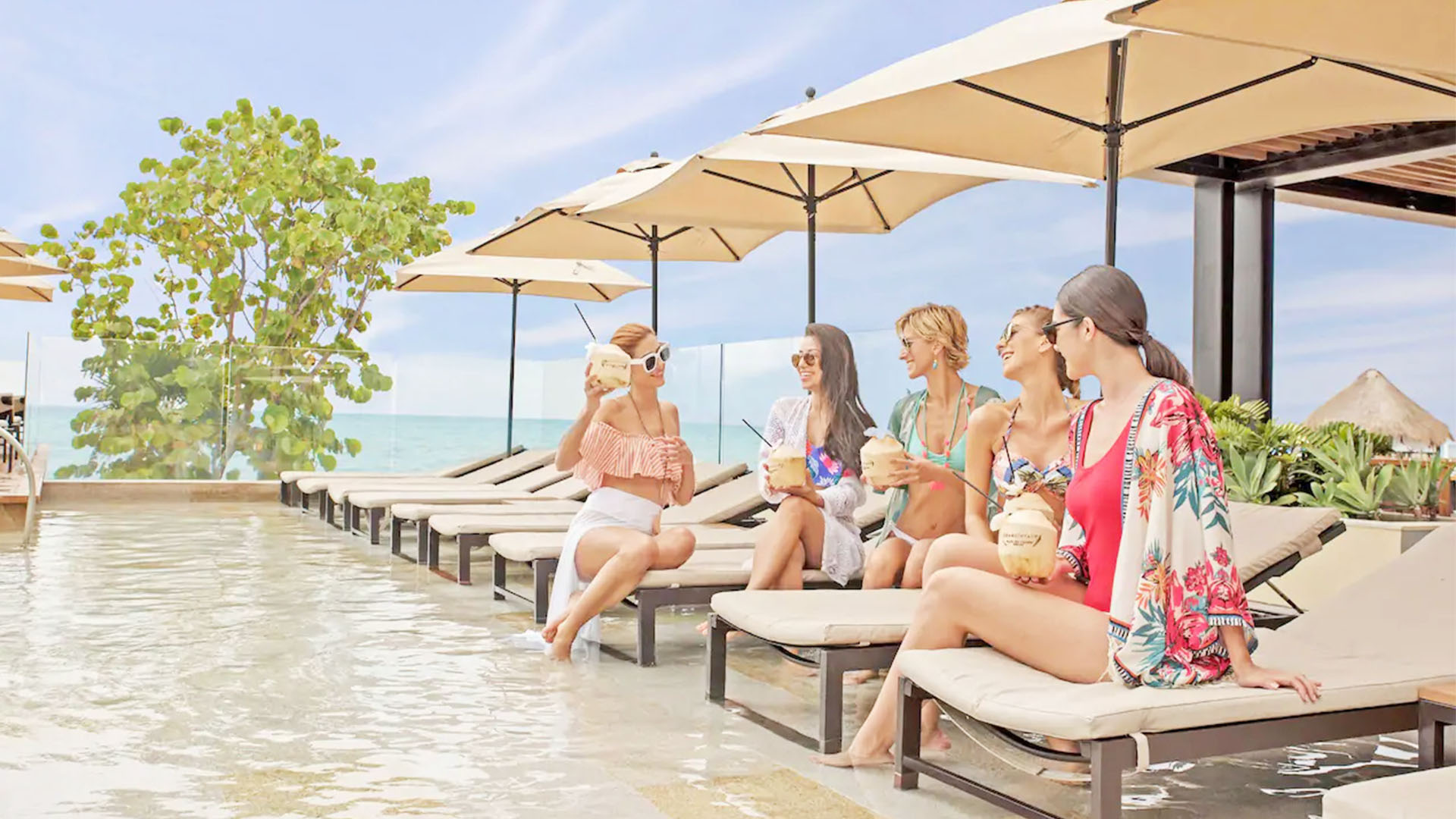
Poolside and rooftop installations subject shade structures to high wind gusts and corrosive moisture environments. Cantilever systems experience intense rotational torque at their pivot points due to their offset arm design.
When specifying a hotel infinity pool cantilever umbrella, engineering teams must account for both vertical uplift and horizontal rotational forces.
🛡️ Structural Reinforcement: Offset poles require reinforced mounting plates secured directly to steel beams or structural deck joists. Surface-level weighted bases are insufficient for elevated winds at infinity pools.
🌊 Corrosion Resistance: Pool chemicals and saltwater mist rapidly degrade low-grade metals. Specifying 6063-T6 Aluminum poles paired with 316 Marine-Grade Stainless Steel fasteners eliminates rust stains on premium deck tiles.

Material Selection & Durability Matrix
Selecting high-durability alloys and weather-resistant textiles ensures long-term performance across commercial installations.
Material Component | Structural / Material Grade | Performance Characteristic | Certification / Testing Standard |
Main Frame / Pole | High strength-to-weight ratio; impact resistant | ISO 9001 Manufacturing Standard | |
Hardware & Fasteners | 304 Stainless Steel / 316 Stainless Steel | Zero rust formation under humidity and salt spray | SGS Salt Spray Tested (500 Hours) |
Canopy Fabric | Premium Solution-Dyed Acrylic | Fade-resistant, water-repellent, UV-blocking | |
Structural Safety | Commercial Frame Architecture | Wind-tested frame stability | EN 581 European Outdoor Safety Standard |
Commercial buyers sourcing via B2B patio furniture wholesale networks should verify that all umbrella models pass formal structural load tests. High-grade shade structures designed for a heavy duty outdoor dining umbrella for bistro applications rely on double-vented canopies to spill excess wind pressure automatically.
B2B Procurement Considerations for ODM outdoor lounge furniture
Scaling a commercial outdoor project requires balancing custom brand aesthetics with structural safety compliance.
Working with an experienced ODM partner enables developers to request factory-customized mounting plates matched to specific deck layouts, ground conditions, and architectural designs.
⚙️ Integrated Mounting: ODM manufacturing allows anchor hardware to be color-matched with powder-coated frame finishes, hiding ugly lag bolts while maintaining structural integrity.
📌 Bulk Project Logistics: Sourcing through established B2B patio furniture wholesale channels ensures uniform engineering standards across large resort properties.

Commercial Anchor Recommendations by Setting
Commercial Setting | Substrate Challenge | Primary Anchor Solution | Recommended Umbrella Type |
Bistro Patio | High Foot-Traffic, Tight Spaces | Flush-Mounted Deck Plates | heavy duty outdoor dining umbrella for bistro |
Hotel Pool Deck | High Winds, Splashing Water | In-Ground Sleeve or Bolted Flange | hotel infinity pool cantilever umbrella |
Beachfront Resort | Shifting Sands, Salt Air | Deep Spiral Sand Augers | Center-Pole Aluminum Patio Umbrella |
Lawn Event Venue | Soft Ground, Temporary Setups | Heavy Ground Screw Anchors | Market-Style Aluminum Frames |
FAQ:
1. How do you secure a commercial umbrella on a wooden deck without drilling through structural joists?
You can use heavy-duty non-invasive deck clamps that attach directly between deck boards to grip the underside of the timber. Alternatively, a low-profile flat steel base weighted with concrete pavers offers stability without requiring board penetration.
2. What anchor depth is required to stabilize an outdoor umbrella in soft grass?
Commercial Ground Screw Anchors should penetrate between 18 and 24 inches into soil. This depth reaches below root zones into compacted dirt, providing sufficient shear resistance against strong wind gusts.
3. Can a cantilever umbrella be safely installed on soft sand?
Yes, but standard surface bases will fail. You must use high-torque Spiral Sand Augers driven at least 24 to 30 inches into damp sand layers, combined with heavy ballast weights or embedded sub-surface mounting plates.
4. What is the difference between 304 and 316 stainless steel mounting hardware?
304 Stainless Steel provides excellent strength and rust resistance for standard outdoor environments. 316 Marine-Grade Stainless Steel contains added molybdenum, offering superior resistance to salt mist, chlorine, and coastal corrosion.
5. How do I choose between surface-mount flanges and in-ground sleeves?
Surface flanges bolt onto existing concrete slabs or timber frames, making them ideal for retrofitting built structures. In-ground concrete sleeves are poured directly into fresh foundations, offering the highest level of wind resistance and a clean, flush aesthetic.
6. What structural safety certifications should commercial shade buyers request?
Look for EN 581 compliance for outdoor furniture structural safety, ISO 9001 for quality management, SGS salt-spray corrosion tests for metal hardware, and TÜV Rheinland wind-tunnel resistance reports.
7. How does a double-vented canopy improve umbrella anchor stability?
A double-vented canopy allows strong wind gusts to pass through the top fabric layers rather than trapping air inside the canopy hood. This reduces vertical uplift on the ground anchors by up to 30%.
8. Why choose ODM manufacturing for custom commercial patio umbrella bases?
ODM manufacturing allows developers to engineer custom mounting systems tailored to unique site conditions. This ensures that mounting bases match specific floor layouts, building codes, and architectural design requirements without sacrificing structural safety.